
VANCOUVER MARTIAL ARTS MMA KICKBOXING


+1 604-298-5425 | Blog
Are you looking for styles and schools? you are are in the right path!
Martialarts.Org Is an information source for all Martial Arts styles, SKF Sport Kickboxing, karate, Tae kwon do, Jujitsu, BJJ, Judo, Boxing, MMA, UFC, wushu organizations and much more including Franchising Schools, educational and certification programs for Instructors, Referees, business management, tournaments, etc!



This site is currently under development
Please fill out the below form to be
notified when the new site is available
Knowledge Base
More and more people come to understand that martial arts is a life time sport. It is the best workout that develops self-confidence and muscle toning, stress relief and relaxation. Our goals are to provide a resource for those interested in studying martial arts and are researching on a style; and to provide information on current martial artists with relevance to their style. We hope to create a global online community where martial artists from all backgrounds can share knowledge and insight into various martial art traditions. We aim to make this the most comprehensive website on Martial Arts in order that first time visitors will make this site as their permanent resource. We are currently in the process of spreading martial arts throughout the world by disseminating information and connecting people. We have a strong team for martial arts research, marketing, and website development. www.Martialarts.org will become a public company soon. We are open to ideas, questions, articles, or comments you may have by sending e-mail info@kickboxing.net We strive to harness the latest technology in service to your needs. “Master” Farhad Dordar” It is important for Instructors and Assistant Instructors to have a broad understanding of the psychology and physiology of instructing in addition to the technical aspects of instructing. We believe that strong Instructors come from being properly trained through a comprehensive Instructor program. The ability to teach is a skill that can be developed with proper instruction and opportunity to practice. Instructors need to learn how to maintain a positive attitude and learn the basic information needed to warm up a class and assist with the instruction of a class. Instructors should also learn how to independently run the warming up period of classes learn about following a training schedule and curriculum that outlines what to do for each class. It is important to develop an understanding of physiology and the effects martial arts training has on the body, and the best ways to prepare the body for martial arts training. An understanding of physiology will help Instructors reduce risk of injury to their students and increase their students readiness for martial arts training. The position of Instructor is an important one because your students use you as an example of what martial arts is and the effect it has on people. Students learn through the example you set. Respect is important for Instructors to understand, explain, and demonstrate to their students. Have a positive attitude, and use yourself magnetism to develop a positive relationship with your students. If you treat your students with respect, and show them that you understand what you are teaching they will trust you, and trust is one of the most important factors in developing a relationship with your students. The Sport Kickboxing Federation has developed a system to train Instructors and Assistant Instructors. Students learn the basics of class management and psychology, anatomy, effective speaking, warm-up and stretching routines, and how to assist in the instruction of a class. Students learn how to teach the technical portion of a class, and how to speak to a class in order for students to get energy and knowledge from the Instructor. Students learn about injury prevention and treatment, as well as procedures for dealing with emergencies in the school. Higher level Instructors learn to teach advanced techniques and combinations. Students learn to direct level lower level Instructors assisting with classes. Students will also learn about different types of body conditioning. Students learn how to pass on their knowledge of discipline and respect to other students and continue to learn how to further develop their charisma and personal magnetism. Students at this level learn about sports nutrition suited for martial arts and what creates the necessary energy for training. Students also learn about specific techniques to boost energy before tournaments, about which training methods and supplements are safe and legal and which are not. Nutrition is an important part of maintaining holistic fitness. If we really want to be the best martial artists we can be, we need to incorporate knowledge of nutrition in our lives. The body uses food for energy, to grow and repair tissue and to regulate and maintain cellular functions. Carbohydrates Proteins Fat How to apply knowledge of the body to increase fitness gains There are certain principles of training that are crucial to understand in order to get the best gains in fitness. For example if the body experiences regular aerobic exercise the cardio respiratory system will respond by becoming more efficient, increased fitness. Another example would be if someone performs the same stretch regularly, over time flexibility will improve as the body adapts. What adaptations occur is dependent on the type of training done. Progressive Overload – As the body adapts to imposed physical stresses it will eventually reach a plateau where no more gains are met. In order to achieve further improvements the load – the intensity – must be progressively increased. Recuperation – During periods of exercise the body experiences a breakdown effect, the catabolic effect. During rest periods the body experiences a building effect, the anabolic effect. In order to get the best results there must be sufficient rest periods for building to occur, the more intense the workout the greater the rest required. The Certification program has been set up for martial artists who believe in knowledge and proper education. The courses we offer in our certification program will give you the best guidelines for developing your skills in many areas, such as quality of instruction, psychology, physiology and anatomy, communication skills, class management, computerized systems, effective speech, organizational strategies for expansion, and much more. Our goal is to bring all martial artists and enthusiasts regardless of gender, culture, and age under one umbrella. This is the time to move forward and make this industry active, professional, and modern. People can either be like an arrow or a target. People who are arrows move forward towards their target, while targets simply sit still and get hit. So be an arrow and follow the instruction and look for the target. Our organization has already found the target. Your target is nothing more than being professional, knowledgeable, and determined. The certification programs at Martial Arts University will help you to ensure that you have all the tools and skills you need to be successful, and will help you move towards your target with accuracy and purpose. Learn martial arts online! www.Martialarts.org is developing a virtual classroom where you can learn martial arts via LIVE online video streaming! Not only will you be able to see your instructor, you will be able to hear them too! Follow along at your own pace with one of our qualified instructors. www.Martialarts.org is developing a comprehensive database of all the techniques you’ll need to know to follow along at each level of our online classes. Diet and Fitness(coming soon) Paid subscribers will have access to advanced fitness tips for the individual who is serious about getting more information, or for the serious martial artist or fitness expert. Certification(coming soon) Become a certified martial artist in different levels through www.martialarts.org . Contact representatives from the SKF through www.martialarts.org and get information on how to become certified to teach, judge, or referee SKF and other organizations events. Also find out how you can become black belt, fighter, instructor, referee, or promoter School Management(coming soon) www.Martialarts.org is developing a database of information for school owners and managers to provide proven and effective methods for increasing the success of your martial arts school or business. We want to be your one stop center for martial arts information, services, and supplies! Martialarts.org has an online resource center for people researching the different styles of martial arts. On Martialarts.org you can view the history of the various arts as well as a technical description of each style. Martialarts.org will help you choose a style that suits you best. Finding a School (coming soon) Martialarts.org is compiling the worlds largest directory of martial arts schools available. Once you have chosen a martial arts style you want to study, Martialarts.org has the tools for you to search for a school in your area. Martialarts.org’s listings cover all styles and areas of the world! www.Martialarts.org allows schools and instructors to list themselves in our database for maximum exposure of your school. Organizations (coming soon) Martialarts.org has information about different organizations and associations that will help you to connect to any organization that you want. E-Mail Services (coming soon) Get your free e-mail address from martialarts.org! No matter where you are you will have access to your e-mail through any web browser. Just log on to martialarts.org, and voila, you’ve got mail! Diet and Fitness (coming soon) Martialarts.org offers a free section on basic diet and fitness tips for it’s members. Learn how to structure your workout and dietary habits for maximum effectiveness! News & Media (coming soon) Stay connected with Martialarts.org! We offer links to online services such as news, sports news, online magazines, streaming video, and Radio Martial Arts. We will notify you via e-mail when new information or services have been added to Martialarts.org! What we call kickboxing today arose out of full contact karate competitions in the 1960’s with fighters such as Bill Wallace, Joe Lewis, Benny “The Jet”, and Chuck Norris. Each fighter had different backgrounds in boxing, karate, or other martial arts, and new strategies and fighting styles developed out of the need for a comprehensive form of fighting that was effective in the ring. What we call kickboxing today arose out of full contact karate competitions in the 1960’s with fighters such as Bill Wallace, Joe Lewis, Benny “The Jet”, and Chuck Norris. Each fighter had different backgrounds in boxing, karate, or other martial arts, and new strategies and fighting styles developed out of the need for a comprehensive form of fighting that was effective in the ring. Kickboxing today is changing to Sport Kickboxing, reflecting the movement of kickboxing towards a martial art which has benefits not only for fighters, but for people who want to gain the benefits of a well rounded martial art that promotes positive results in both mind and body. Not understanding why people had to suffer, he set out on a quest to the forest to search for truth. He searched for 14 years, virtually alone in the jungles of India. One day while sitting under a bodhi tree he became enlightened and afterwards traveled all over Asia in order to teach others this path towards enlightenment. He became known as the Buddha. One of his disciples, Bohdidarma, later travelled to China to enlighten people there. With the amount of traveling and different people he encountered he realized that his body and those of his disciples were not strong enough to endure their journey to bring enlightenment to others. He developed repetitive exercises that would strengthen the body, which he taught his disciples. Martial arts eventually moved to Okinawa through traders from the Fukien Province of China , and was developed into a martial art known as Okinawa-te. Okinawa-Te was not the only form of martial arts being developed in Japan at the time(judo, kendo, bo etc), however they all seem to have originated from Zen Buddhism (the Japanese adaptation of Buddhism). In the 8th century, what became today’s Sumo, was an art which had techniques attributed now to Judo and karate. Martial Arts really blossomed around the time when the Buddhist priests began to train to reach “illumination”. Around the 7th or 8th century, these Buddhists brought back to Japan techniques studied in China whilst there were staying at Sui and Tang courts. Martial Arts was practiced for most part by those in Zen Buddhist temples and remained secret for many years. Okinawa Later, in 1392, 36 Chinese families were relocted to Okinawa, and their style of martial arts, kenpo(chinese boxing’ was absorbed into Okinawan martial arts and formed the basis of Okinawa-te. The origin of today’s four major Japanese karate-do systems (Shoto-kan, Shito-ryu, Goju-ryu, and Wado-ryu)can be traced to a group of islands known as the Ryukyu Island chain during the 18th century. The chain is located between Japan (North-East), mainland China (West), and Taiwan (South-West). Okinawa is the largest of the islands and there was an native martial art form that was being secretly practiced called ‘Te’ or ‘hands’. Some of the features of Okinawan karate included the use of the fists, toes, elbows, and knife hands. It is the use of fists that are unique to Okinawan ‘te’. Okinawan ‘te’ was heavily influenced by cultural exchange with Asia, especially China. Over time, the secret martial art practiced by the Okinawans, ‘Te’, was combined with various Chinese martial arts fighting styles that evolved into a system referred to simply as ‘To-De’ or ‘Chinese Hand’. Shaolin boxing found it’s way to Okinawa from China in the 16th Century. Over the years it combined with Okinawan techniques to eventually form many different styles. Unarmed combat became especially important to Okinawan society when the owning and carrying of weapons was banned during several periods of Okinawan history. The first ban was made by an early Okinawan king, Sho Shin, who wanted to consolidate his power, and later in 1609 by the Satsuma Clan from southern Japan, who conquered Okinawa in that same year. This ban lasted almost 300 years, and rather than the art of te disappearing, training went on in secret. The martial arts were passed down from father to son in secret, for fear of being caught. Each ban led to greater advancements in techniques for unarmed fighting. The result of these bans then was twofold: Karate was only practiced in secret, and kobudo, which involves the martial use of common household and farming implements, was born. During this time, Okinawa traded heavily with the Fukien province of China, and one of the imports was Kempo, Chinese Boxing. The art was originally known as Okinawa-te, but later became know as kara-te. Karate actually has two meanings, one for each of it’s cultural roots. Karate means “empty hand” in Japanese, and in Chinese Karate meant “Chinese hand”. Most likely the term karate meant “Chinese Hand” at this point in history. In the 18th century te developed in three main areas of Okinawa; Shuri, Naha, and Tamari. The styles that resulted were called Shuri-te, Naha-te, and Tamari-te. NAHA TOMARI SHURI The system of the Tomari region became absorbed into the Shuri system because of lack of development in Tomari. This gradually left only two main systems, referred to as Shorin-ryu, from Shuri-te and Shorei-ryu, from Naha-te. Gichin Funakoshi characterized Shuri-te/Shorin-ryu as quick in it’s movements, and as a good style for smaller men, while Shorei-te he said worked better for heavier people. The differences between styles can be seen in their patterns of movement and breathing. The movement in Shuri-te is a natural style of movement, with the feet moving quickly forward and backward in straight lines. Breathing is also of a natural rhythm and there is no perscribed method of breathing. Naha-te’s style of movement is more solid and slower than Shuri-te and the feet travel in half moon shapes rather than straight forward and back. Ankoh Itosu was born in Shuri and became one of the most respected martial artists in Okinawa during the 19th century. He was the first individual to introduce To-De in 1904 and began the transformation of to-de from a feudal martial art to a sport based martial art. Master Itosu also organized and systemized To-De into a standard method of practice and created the Pinan katas for beginning martial artists. Master Itosu trained a great number of eminent karatemen, including Kentsu Yabu (1863-1937), Chomo Hanashiro (1869-1945), Gichin Funakoshi (1867-1957), Moden Yabiku (1880-1941), Kanken Toyama (1888-1966),Chotoku Kyan (1870-1945), Shinpan Shiroma (1890-1954), Anbun Tokuda (1886-1945) and Kenwa Mabuni (1889-1952). Kanryo Higaonna was born in Naha in 1853. He began training in the martial arts with a Chinese Kempo stylist when he was around 16 years old. His fascination for this Chinese fighting-art form lead him to train in Foochow, China for approximately 15 years. After returning to Okinawa, he was eventually convinced to teach his system of martial arts. It was during this period that he introduced the hard (go) and soft (ju) methods of training. Kanryo Higaonna was also considered to be one of the most highly respected martial artists in Okinawa during the 19th century. Master Higaonna had many students among whom were Chojun Miyagi (founder of Goju-ryu), Juhatsu Kiyoda (founder of Toon-ryu, Kanken Toyama, and Kenwa Mabuni (founder of Shito-ryu). Gichin Funakoshi developed the martial arts style Shoto-kan karate. In 1922 Gichin Funakoshi and Choki Motobu went to Tokyo and Osaka and introduced Japanese society to martial arts, and in 1931 was officially adopted by the Nippon Butoku Kai association of martial arts. At this time this form of martial arts was simply called To-De. In 1936 a group of masters, Chojun Miyagi, Chomo Hanshiro, Choki Motobu, and Chotoku Kyan agreed that this martial art should be called karate, or open-hand. Open hand refers to a weaponless martial art, rather than having one’s hands open. Shotokan Karate is characterized by powerful linear techniques and low, deep, strong stances. The emphasis in Shotokan is on maintaining correct body posture and in perfecting the basic techniques. Techniques should be sharp, strong, and without error. Part of the discipline of Shotokan Karate is maintained thrugh it’s mastery of basic techniques. He gave a demonstration in 1916 to the Butokuden in Kyoto Japan, then the center of all martialm arts in Japan. In 1921 Gichin Funakoshi gave a demonstration of karate to the future Emperor of Japan, and in 1922 travelled to Tokyo to present karate to the Ministry of education. His style was so popular that he remained in Japan to teach his style, and never returned to Okinawa. Funakoshi taught martial arts as a life style – a way of living which required discipline and dedication to the precepts of martial arts. His style synthesized Okinawan martial arts into a strong system of martial arts. This method became known as Shotokan, literally the house of Shoto, which was the Funakoshi’s pen name for his poetry. Shotokan also refers to the sound of wind blowing through pine trees. At the age of 70, Funakoshi opened his own dojo, which was called Shotokan. The founder of Shito-ryu was Kenwa Mabuni. He was born in Shuri, Okinawa in 1889. As a child, he was quite ill and not very strong. In 1902, at the age of 13, his family brought him to Ankoh Itosu, the most famous martial artist in Shuri, to try to improve his health. While he was in Naha he also received instruction from Seisho Arakaki who taught a similar style to master Higashionna. Arakaki was a weapons(kobujitsu) teacher and taught Kenwa Mabuni various weapons forms and techniques. Kenwa Mabuni was also influenced by Wu Xian Gui, a White Crane fist master in the Fukien province of China. After he completed military service, he moved to Osaka, Japan, and started to teach out of his house. He also had become a police officer and taught at police stations and Universities in Japan. In order to promote his style of martial arts, Kenwa Mabuni gave public demonstrations where he would break bricks and boards to show the effectiveness of karate. In 1931 Shito-ryu was accepted as a style of martial art by the Dai Nippon Karate-do Kai association. This group later was later renamed the World Shito-Kai Karatedo Federation. The name Shito-ryu was taken from the first charatcer of each of Kenwa Mabuni’s teacher’s names. The first charatcer came from Itosu’s name, “Shi”; the second charcter came from Higaonna’s name, “to”. Thus originated Shito-ryu Karate. Ryu means style. Shito-ryu karate-do uses a large number of kata – approximately fifty – and the style is characterized by an emphasis on power in the execution of techniques. The founder of Kyokushin Karate, Masutasu Oyama, was born on July 12th, 1923 in Korea, and immigrated to Japan as a young boy. Upon arriving in Japan he took the name Oyama, meaning”Great Mountain” in Japanese. Sensei Oyama studied karate under Giko Funakoshi (the son of Gichin Funakoshi, founder of Shotokan Karate), and later studied martial arts in isolation in order to increase his understanding of the martial arts. To demonstrate the power of his karate, Mas Oyama began fighting with Bulls in 1950. In total he fought 52 bulls, killing 3, and taking the horns of 49 with knife hand blows. Only once did he get injured, being cored through the side. He still managed to take the bull by the horn and defeat his opponent before going to the hospital to recover. Kyokushin training is noted for being very rigorous and it’s belief in fighting with hard contact to simulate a realistic situation. This form of karate believes that this contact serves to allow students to realize how strong their body and spirit is, and helps to prepare the student for fighting in a real situation. The phrase “osu no seidhin”, perseverance under pressure, signifies this belief. Mas Oyama started a tradition unique to the Kyokushin style, the One Hundred Man Kumite. Each person in the kumite has to fight 100 other Kyokushin fighters in a full contact match lasting two minutes each. If a fighter is knocked down to the ground for more than 5 seconds, the fighter would lose the contest. The fighter with the most full points, and the one that threw the most offensive techniques, would win the contest. Mas Oyama himself fought 100 opponents a day for three consecutive days, and did not continue on the fourth only because there were no more opponents left to fight! To this day there are only 13 other people to successfully complete this challenge. Mas Oyama died in 1994, leaving Kancho Shokei as the head of the Kyokushin organization. He was the winner of the 12th, 13th and 14th World open Karate Championship, and successfully completed the 100 man challenge in 1986, compiling the most knockdowns and wins in this challenge of any competitor ever. Confirming his status as the current day premiere Kyokushin stylist is Mas Oyama’s will, naming him his one and only successor as the heir of Kyokushin Karate.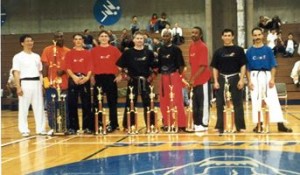 Martial Arts is known for its positive benefits on people regardless of their age, gender, or culture. Countless Martial Arts techniques had been developed throughout the world, spanning cultural, geographical and time differences. Masters not only impart their martial arts styles to their students – they pass on the disciplines and philosophies that varied cultures had created through the ages.

Nutrients are the chemical substances found in foods necessary for health; they can be broken down into six groups: Carbohydrates, Water, Fat, Vitamins, Proteins, and Minerals The body uses carbohydrates, proteins and fat to produce energy.
Carbohydrates are classified as simple (sugars) and complex (starches) and are found in most foods except for pure fats.During exercise the body predominantly uses carbohydrates for fuel. To optimize energy carbs should be the major nutrient in one’s diet 50-65%; foods rich in complex carbohydrates should be consumed every meal.
Proteins are necessary for body growth, repair, making and maintaining enzymes, antibodies and blood. Proteins are comprised of amino acids. The human body uses 22 amino acids, 9 of these cannot be made by the body and are called essential amino acids, the body manufactures the other 13 nonessential amino acids. Foods containing all of the 9 essential amino acids are called complete proteins.
Complete proteins usually come from animal based foods such as meat, fish, eggs and dairy. Incomplete proteins are those missing some of the essential amino acids, in order to form complete protein these need to be eaten in combination with other foods in a 24 hour period. Incomplete protein foods include vegetables, grains, legumes and nuts.
Fats are the most energy dense of all three energy-containing nutrients. Fat is used to produce hormones, immune system components, and cell membranes. Fats also contain fat-soluble vitamins. There are three primary categories of fat; saturated, monounsaturated and polyunsaturated. Saturated fat comes from animal fats such as beef, pork and dairy as well as from some tropical sources like coconut and palm oils. Monounsaturated fat comes from olives, peanuts, avocados and canola. Polyunsaturated fat comes from most plant oils such as sunflower, corn, sesame, soy and flax seed. Cholesterol is found only in animal fats and should be avoided as much as possible. Adaptation – the body adapts to physical stresses imposed on it.
 Virtual Classes (coming soon)Choosing a Style (coming soon)
Kickboxing
 Kickboxing combines the techniques and strategy of both boxing and kicking, and is one of the most popular and fastest growing martial arts today.
 Over time this fighting style became known as kickboxing, and new organizations were created to promote kickboxing tournaments and to train fighters. Kickboxing has gained recognition as a highly effective martial art for both ring fighting and for holistic fitness. Students learn the effective use of both boxing and kicking techniques, which makes students confident in self defense, and also helps them develop strong bodies.
While kickboxing fist developed as a martial art for tournament fighting, in recent days kickboxing has become very popular, especially with women, because the kickboxing workout is excellent for developing body toning, burning fat, and at the same time developing confidence. According to numerous legends, martial arts seems to have his origins in South East Asia or India. Siddartha Gautama was a prince in northern India around 560 BCE.
Being a prince, he was never allowed to leave the palace grounds. Letting his curiosity get the better of him, he looked outside one day only to see many of his subjects suffering in poverty.
These training methods were later adopted by the monasteries of the Shaolin Temples in China, where the techniques were refined by succeeding Shaolin masters to become the powerful and graceful Shaolin Temple boxing. Over many years of refinement, the Chinese developed the martial arts into Kempo and Shaolin Kung-fu.
 The martial arts of the Okinawa Islands dates back to the 7th century. Chinese martial arts were introduced to Okinawa through Chinese taoist and buddhist monks late in this century.
Naha’s most famous master in the development of ‘Naha-Te’ was Kanryo Higashionna (1853-1915). He received instruction from master Arakaki (1840-1918). Kanyro Higaonna was a To-Te practitioner in the late 19th Century and taught To-Te forms in Okinawa, but he modified the forms to include the Okinawan style closed fist, rather than the open hand techniques of to-te. Master Higashionna taught many students including Chojun Miyagi (1888-1953), the founder of Goju-ryu,and Kenwa Mabuni (1889-1915), the founder of Shito-ryu.
In Tomari, two great masters became important historical figures in the development Tomari-te. They were Kokan Oyadomari (1831-1905) who taught Chotoku Kyan (1870-1945) and Kosaku Matsumora (1797-1898), who taught Ankoh Itosu (1830-1915).
Shuri’s main teacher in the development of Shuri-te was master Sakugawa (1733-1815), who was widely known by the nickname of To-De Sakugawa. Sakugawa learned To-De in China and it is said he received instuction from Peichin Takahara and from a Chinese military officer‚ known as Ku-San-Ku, who was an expert in the art of Chinese-Boxing. His most recognizable student was Sokon Matsumura (1809-1894) who was Ankoh Itosu’s teacher.
Shotokan Karate
 Gichin Funakoshi was born in 1868 and began the study of karate when he was 11 years old. His primary teachers were Yasutsune Azato and Itosu. Gichin Funakoshi is considered by Shotokan stylists to be the ‘father’ of modern karate due to his efforts to introduce Karate to Japan. Gichin Funakoshi was the first karate-do practitioner to bring karate to mainland Japan.
Shito-ryu Karate

Seven years later, in 1909, Kenwa Mabuni went to Naha and began training with Kanyro Higaonna at the urging of his Intructor, Itosu, and his friend, Chojun Myagi(the founder of Goju-ryu). Find any below information about: martialarts,martial,arts,kickboxing,kick,boxing,mma,mixed,karate,taekwondo,tae,kwon,do,juitsu,BJJ,kenpo,kendo,kyokushinkai,self,defense,women,men,children,youth,world,equipment,tournament,ring,fight,fighting,fitness,Canada,USA,Unitedstate,united,state,Arab,Emarate,Japan,Korea,Iran,IRI,Islamic,republic,of,Iran,islamicrepublicofiran,Kitsilano,Burnaby,Surrey,Ottawa,Ontario,Alberta,Calgary,Victoria,France,Germany,UK,Englan
Kyokushin Karate
 Kyokushin Karate as envisioned by Sensei Oyama is a discipline which can focuses as much on physical discipline as it does on the spiritual development of the individual. “Kyokushin” is composed of of two words, Kyoku (ultimate) and Shin (reality or truth from within). The physical discipline is necessary for the development of mental discipline. Kyokushin Karate teaches practical kicks, blocks, punches and movement as well as mental discipline. The use of circular movement in the execution of techniques distinguishes Kyokushin Karate from other traditional styles of Karate, which rely on linear motion.
Kyokushin philosophy is stated in the following quote from Sensei Oyama, “1000 days of training a beginner, 10000 days of training, a glimpse of the mysteries”
In order to successfully navigate this challenge, a Kyokushin fighter must understand the philosophy “osu no seidhin”, or perseverance under extreme pressure. No other style has a challenge like this one.